The Majority of Ratepayers and U District Community Members Do Not Support This UDP-BIA Proposal
A major problem is the way the UDP-BIA proposal has perverted a modest funding process that was originally intended to allow a small group of local businesses to create more parking options for their local commercial core area. To set up the BIA, the City will rely on a City Council resolution, rather than the usual practice of a petition signed by ratepayers charged with 50% or more of the assessments (i.e. the petition is based on wealth - not individual people in the district). The UW will donate 46% of the anticipated revenues; its contribution is not an "assessment" because the City has no power under the enabling legislation to tax the state. The signers (most of who are associated only with the core commercial area on the Ave) of the petitions accounted for only 21% of the gross revenue. Those who did not sign equal 33% of the gross revenue. The supporters will pay less than 39% of the total assessed excluding the UW contribution. If support is measured in terms of individual businesses, instead of adding up a few high valued properties controlled by only a few businessmen (none of which live in the U-District), then paradoxically the numbers reverse with more than 60%
OPPOSING the UDP-BIA. If you consider support only on the far west side of the UDP-BIA area then the support starts to approach zero with many potential rate payers actively incensed by the their hard earned income being used to support 'big business' on the Ave. It is clear that the proposed UDP-BIA is not representative of neighborhood and community groups. It is an ASTRO TURF organization, not a grass roots one!
The UDP-BIA proposal was developed in a deeply secretive manner with any concerns by anyone outside of a small 'clique' of Ave businesses interests unwelcome. For instance, while the City held a multi-year planning process with public meeting on plans for upzoning the U District at none of the meetings did anyone disclose the proposed boundaries of the UDP-BIA, the way assessment would be levied, or give any examples of the likely charges. Most residents and many businesses first learned about the proposed assessment in a recent letter from the City. In addition the UDP organization enshrines language that severely restricts new board members to only people the current board members approves of. The UDP rejected a request from the University District Community Council for representation by any of the three community associations in the area. The UDP-BIA will write its own by-laws. At its behest the Finance Director may contract for a five year duration with the UDP as program manager. The ratepayers as a whole do not get to vote for the members of the ratepayer's advisory board or the management contract of the UDP-BIA. Unlike earlier BIA ordinances the UDP-BIA draft ordinance does not require the ratepayers advisory board or program manager to comply with the Open Meeting Act, the Public Records Act, or the City's Code of Ethics nor does it allow a ratepayer aggrieved about an expenditure to file an appeal to the city hearing examiner.
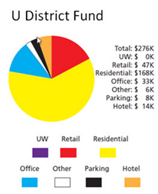
Most of the financial burden for marketing, "advocacy," and economic development activities falls on apartments, condominiums, and mix use residential buildings. The
pie chart on the left show that the residential units would pay 61% of the budget while retails, hotels and parking pay only 25% of the total budget. The Fund will be used to do those promotional activities concentrated on the Ave and the core around the sound Transit station. These activities confer
special benefits on businesses and parking lots; other parts of the big UDP_BIA district get vague
general benefits. The University Plaza Condominium near the northwest corner of the assessment district will pay much more than the University Book store, the by far biggest retailer at its very core. The Malloy Apartments on 15th Ave. N.E. built before WW II will pay $3,786; the University Bookstore Parking lot to its immediate south pay $829. Some business activities, such as City utilities and Sound Transit, will get UPD_BIA cleaning services will pay
nothing at all! Home and duplexes were exempted because the enabling legislation does not permit their assessment.
People also have reason to be troubled by the potential dominance by the UW. The UW will be guaranteed a significant number of seats on the controlling BIA board. In situations where only a small quorum is present it is easy to see were the UW could have a controlling voice if most of the 'regular' board meters were absent. In addition, since the UW contribution is voluntary, its contribution could be withdrawn if the UW becomes displeased with the BIA activities. The UW contribution is such a large part of the BIA budget that it represents a serious unspoken threat of "taking my ball and going home" that other board members cannot be expected to ignore. This danger is particularly problematic since the current budget and program guidelines for the UDP-BIA are so vague it would be relatively easy to bias BIA activities to support UW interests at the expense of local neighborhood and community groups
RETURN TO HOME PAGE